Off grid wind turbines can be classified based on multiple dimensions such as generator type, rotation axis direction, power capacity, structural form, and driving mode. The following is a detailed introduction:
Classified by generator type
Off grid wind turbine system based on asynchronous generator:
The use of asynchronous generators as energy conversion devices can be divided into cage type asynchronous generators, wound type asynchronous generators, and doubly fed asynchronous generators.
Cage type asynchronous generators have the advantages of low cost, high reliability, and robustness, and are widely used in the field of traditional off grid wind turbine systems.
Off grid wind turbine system based on permanent magnet synchronous generator:
Permanent magnet synchronous generators have become mainstream due to their high efficiency and small size.
According to structure, it can be divided into various types such as radial magnetic field inner rotor motor, radial magnetic field outer rotor motor, axial magnetic field dual stator slotted motor, axial magnetic field dual rotor slotted motor, and stator balanced single-sided axial magnetic field motor.
Under the same rated parameter conditions, the power density of axial magnetic field motors is greater than that of radial magnetic field motors; Bilateral axial structure has advantages over unilateral axial structure; The outer rotor radial magnetic field motor has advantages over the inner rotor radial magnetic field motor. The radial magnetic field inner rotor motor has the simplest structure and lowest manufacturing cost, making it very suitable for small off grid wind turbine systems.
Off grid wind turbine system based on switched reluctance generator:
Compared to permanent magnet synchronous generator systems, the market share is relatively small.
Classify by rotation axis direction
Horizontal axis wind turbine:
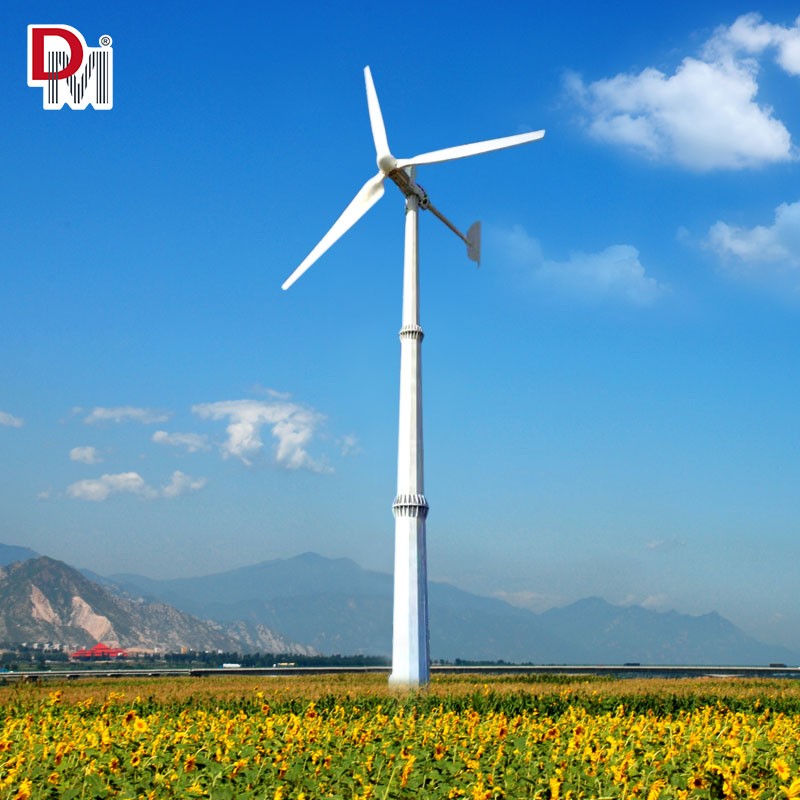
The rotation axis of the wind turbine is parallel to the ground, and the blades are similar to propellers, which need to be aligned with the wind direction.
Mature technology, high efficiency (up to 45% or more), and high single machine power (mainstream models).
The yaw system needs to be responsive to wind, and the tower is relatively high, resulting in relatively high noise levels.
Application: It accounts for over 95% of the global wind power installed capacity and is widely used both on land and at sea.
Vertical axis wind turbine:
The rotation axis of the wind turbine is perpendicular to the ground, and the blades rotate around the vertical axis without the need for wind.
Simple structure, low noise, strong resistance to sudden changes in wind direction, and easy maintenance.
Low efficiency (usually<40%), high start-up wind speed, and difficulty in scaling up.
Applications: small-scale distributed power generation, urban environment, auxiliary energy, etc.
Classified by power capacity
Micro wind turbines:
Capacity below 1kW, suitable for household or small power load points.
Small wind turbines:
The capacity is between 1kW and 10kW, suitable for remote areas, pastoral areas, or single power supply targets.
Medium sized wind turbines:
The capacity is between 10kW and 100kW, suitable for distributed power generation scenarios.
Large scale wind turbines:
With a capacity exceeding 100kW, it is mainly used for grid connected wind power plants.
Classified by structural form and driving mode
Gearbox type:
The wind turbine drives the generator by increasing the speed through the gearbox.
Advantages: Can use high-speed generators (low cost).
Disadvantages: The gearbox requires frequent maintenance and has a high failure rate.
Direct drive type:
The wind turbine directly drives the low-speed permanent magnet synchronous generator, eliminating the need for a gearbox.
Advantages: High reliability and minimal maintenance.
Disadvantages: High cost of permanent magnets and large volume/weight of generators.
Mixed type:
The wind turbine drives the medium speed generator through a first stage gearbox.
Balance point: Balancing reliability (gear simplification) and cost.